
News and Events
Showing 5 of 257 news items
Page 45 of 52
Latest Updates
News & University Events
Updates from across TNJFU.
 University News
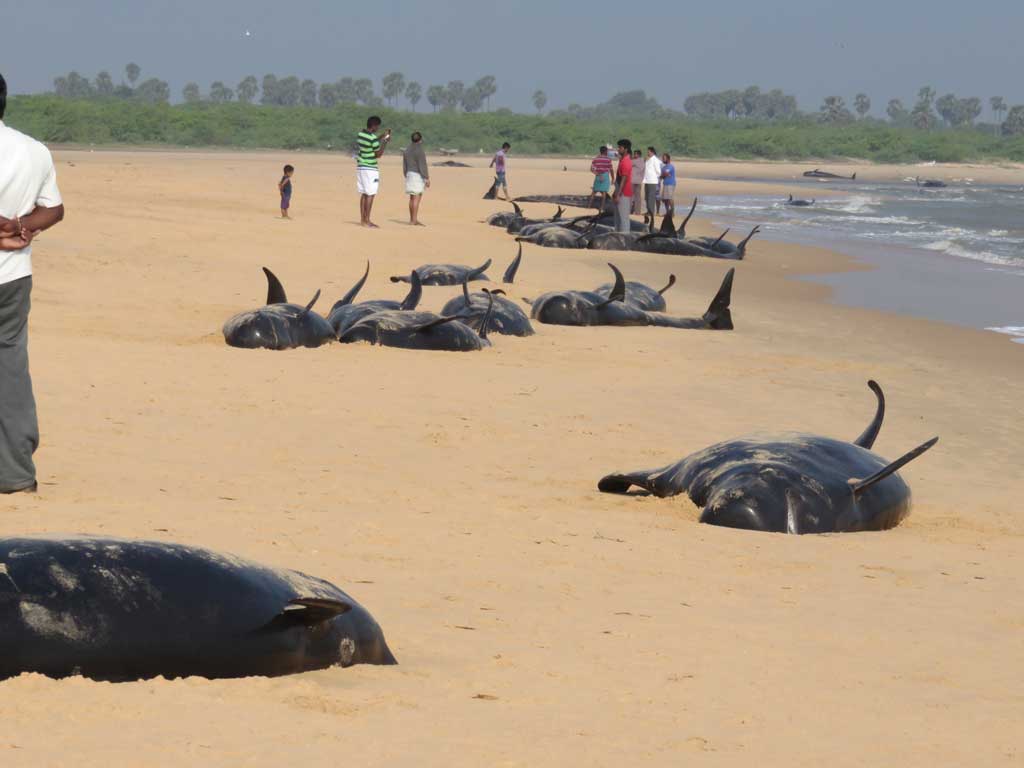
Mass stranding of whales in Manapad coast of Gulf of Mannar, South East Coast of India
On the night of 11.01.2016 the TV news channels have broadcasted the news of mass stranding of whale in the coastal region of Aalanthalai, near Tiruchendur in Gulf of Mannar. The Dean, Fisheries College and Research Institute of Tamil Nadu Fisheries University, Thoothukudi deployed a team of Scientists of FC&RI, Thoothukudi to the whale stranded coast of Aalanthalai. The Scientific team headed by Dr.A.Srinivasan, Chair, School of Fisheries Resources and Environmental Management with Dr.P.Jawahar, Professor, Dr.P.Chidhambaram, Associate Professor Dr.S.Aanand, Assistant Professor and PG Scholars reached the spot by 4.00 a.m. and surveyed the coastal beach for the stranded whales. The team could locate only two whales which were struggling in the intertidal region of Kallamozhi, near Aalanthalai. With care they were pushed back to the sea with the help of locals. In the morning, we came to know that considerable number of whales are stranded in the Manapad coast. Then the team went to the Manapad coast and found approximately 80 numbers of stranded whales belonging to the species, Globicephala macrorhynchus, which is commonly known as Short finned pilot whale, in the intertidal and supralittoral zone (upper intertidal zone).He also told that this species is a carnivorous one and feed mainly on pelagic fishes and squids. They usually move in groups (pod) and has strong social bonds among them. The female matures at an age of 8-9 years and males at an age of 13-17 years. Generally they live for about 60 years. Females give birth to a single calf with a gestation period of 15 months. The calving interval was reported to be 5 to 8 years. Among the stranded whales some were alive and some were dead. The team joined with the whale rescue teams organized by the District Administration, Wild Life Department, State Fisheries Department and the public. The whale rescue team could rescue only about 36 whales. The rescued, whales were found healthy and swimming in the inshore waters. In this regard, our team has also made inquiry to confirm the published report about the previous strandings by this species during 1973 in the same location and the local people (women aged 70) confirmed that similar incidence occurred before 43 years in this coast. The team has also made an observation on the water temperature, salinity and dissolved oxygen content of the inshore region, which were found to be normal. There are several reasons attributed for mass stranding of whales all over the world. In this case, although the exact reason could not be ascertained, it could be predicted that these whales might have chased the prey (small fishes like sardines and other inshore school of fishes) in the intertidal areas during last phase of the highest high tide period (new moon day periods) and later must have stranded because of shallow depth created by receding tide, during which they must have faced the problem of disorientation.
Read full article University News
Scholarship available for * International Training Programme on Health Management in Aquaculture*
International Training Programme on Health Management in Aquaculture Background As the aquaculture sector evolves from an artisanal venture to a highly specialised bio-industry, diseases and health management are becoming a major concern. The general lack of basic knowledge on disease prevention and health management has driven farmers to the injudicious use of antibiotics. These practices are a threat to public health and moreover further compromise sustainable production due to microbial resistance issues. Although research is steadily making progress in understanding aquatic health issues and proper remedies are gradually being developed, a vast majority of farmers and specialists, especially in developing countries, still has no awareness of or access to this knowledge. Rationale The joint research efforts of Ghent Universities’ Aquaculture R & D consortium has led to ground-breaking developments in the fields of diseases in aquaculture, microbial community management, virology and immunology that may contribute to increasing the sustainability of disease control strategies applied in aquaculture. To respond to the lack of awareness on sustainable strategies to handle aquatic health issues, not only at the industrial level but also at the academic level, this consortium now organises a short specialised training programme on Health Management in Aquaculture. This programme aims at *disseminating the state-of-the-art and increasing awareness* on the latest developments in sustainable aquatic health management. Targeted participants (20 max) Aquaculture farm managers, veterinaries and biologists active in business, research, higher education, policy making, outreach & dissemination. Learning outcomes The ITP on Aquatic health management will contribute to local research and education needs by: Training local experts in new concepts in disease prevention and curative techniques Give hands-on training based on real local issues delivered by the participants Provide tools for dissemination of newly acquired knowledge and skills Welcome newly formed disseminators in a growing network of peers. Admission requirements Selection criteria include Academic proficiency (MSc level) or equivalent by experience (Agricultural engineer, Biology, Veterinary medicine or analogues) Language proficiency (e.g. IELTS 6.5 or similar) (except for ex Ugent master students) Active in health management in aquaculture is recommended Envisaged multiplicator effect (does the candidates’ position guarantee effective dissemination of the acquired expertise) Academic selection will be entrusted to the ITP Board which consists of the main lecturers involved in the programme. Programme The training programme consists of lectures, case studies, peer-to-peer teaching on the one hand and on the other hand practical wet lab experience on biofloc operation and study visits. The lectures, which will include microteaching sessions, will make up the majority of the program. For a period of 10 weeks, the 4 courses (Diseases in Aquaculture, Virology, Microbial Community Management, Immunology) will be taught. Lectures are given by UGent experts (Prof. Peter Bossier, Prof Hans Nauwynck, Prof Annemie Decostere, Prof Daisy Vanrompay, Dr Peter De Schryver) and guest lectures by international authorities (Prof. Yoram Avnimelech, Prof. Jorge Galindo-Villegas; Prof. Olav Vadstein). Training programme details Tuition fees South country participants (according to the current VLIR country list 3000EUR Other country participants 5000EUR VLIR scholarship holders: waived *Scholarships* Scholarships are available from VLIR-UOS *Duration* 19 September 2016 – 12 December 2016 *Location* Laboratory for Aquaculture & Artemia Reference Center Coupure Links, 653 9000 Gent
Read full articleUniversity NewsApply online for Education Loan- www.vidyalakshmi.co.in
Apply online for Education Loan
Read full article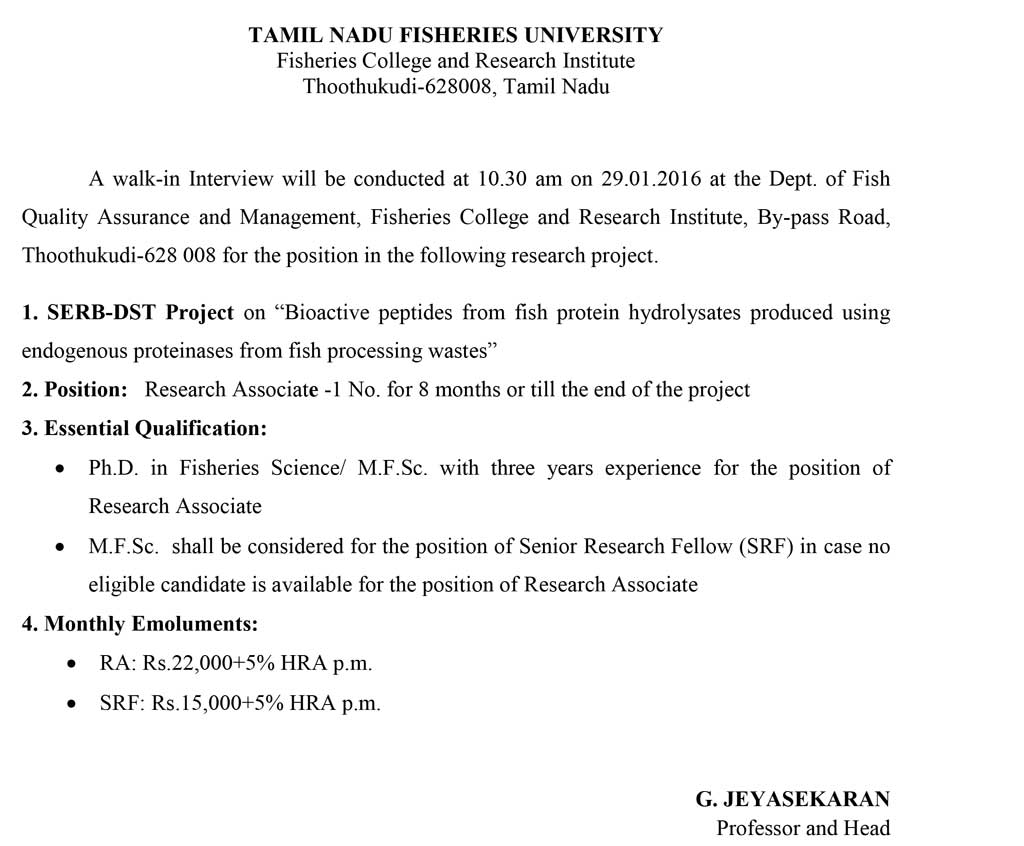 University News
Walk-in- Interview on 29.01.2016 at DFQAM ,FCRI,Thoothukudi for RA/SRF in SERB-DST Project
Read full article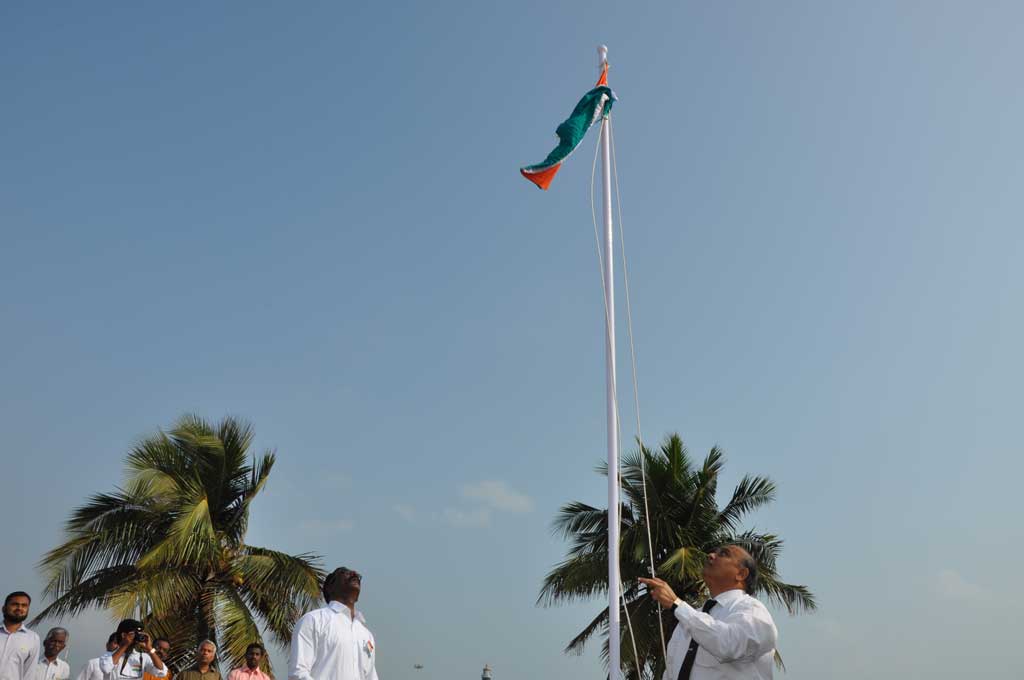 University News
Republic Day Celebration Tamil Nadu Fisheries University Nagapattinam , FC&RI Thoothukudi , FC&RI Ponneri
Action taken Report on the observance of World Fisheries Day (November-21) Fisheries College and Research Institute, Thoothukudi, a constitute college of Tamilnadu Fisheries University, Nagapattinam celebrated the 67th Republic Day in a grand manner. The students and staff of Fisheries College and Research Institute participated in the programme. The Dean Dr.G.Sugumar was escorted to the Dias by the Security Staff Commander and the Students’ Captain along with Dr.S.Athithan, Sports Secretary. A guard of honour was performed by the Security staff and the students. Dr.G.Sugumar, Dean unfurled the National Flag and the College Staff, Students and Security Personnel honoured the National flag. In this republic day address he spoke on the history and importance of India becoming a republic and the schemes launched by Indian government to take our nation on a progressive path. He mentioned the significance of Skill India Mission, Digital India, Make in India initiative, Start-up India and Stand-up India launched by our Prime Minister, and emphasized the role to be played by all true citizens of the Nation. On this occasion, Dr. G. Sugumar, the Dean presented the Best Worker Awards to Mr.R.Subbiah, Basic Servant, Mr.A.Aridhas, Attender for their best performance during the year 2015. A Special Appreciation Award to Mr.P.Robert, Sub-Inspector of Fisheries and appreciation awards to Mr.M.Ramachandran, Mr.S.Pugal Sampath, Mr.A.Sermakkan for their commendable work during the flood in the month of November 2015. Dr.G.Sugumar Dean Fisheries College and Research Institute, Thoothukudi – 628 008. The 67th Republic Day was celebrated at Fisheries College and Research Institute, Ponneri on 26th January 2016. The Dean hoisted the flag and delivered the Republic Day address, where he briefed the importance of the constitution and the great work done by the intellectual leaders of the country. He also announced the Appreciation Award to the Department of Aquaculture for their tireless efforts in developing the three centres namely Advanced Research Farm Facility, Madhavaram, Pulicat lake Research Field Facility , Pazhaverkadu and Brackish Water Research Farm Facility, Vaniyanchavadi. All the teaching faculty, Non – teaching faculty and students participated in the Republic day celebration. In this connection a Staff Vs Students Volley Ball match was conducted and the match was won by the staff team.
Read full article